Nigeria Serranted Greenhouse For Tropical Climate
The cost and construction cost of substrate cultivation are the lowest in soilless cultivation, and its practicality is significantly better than other soilless cultivation models.
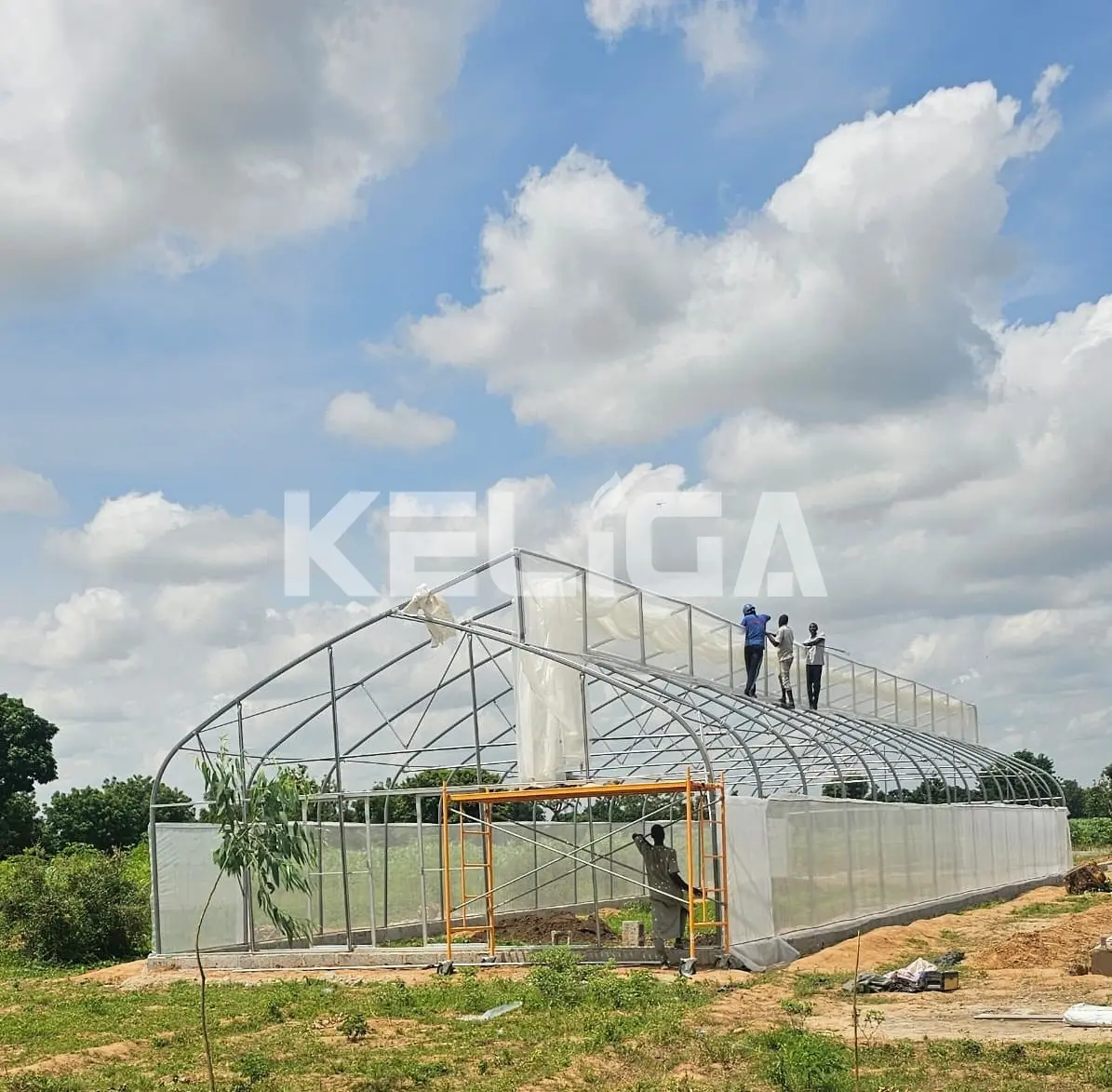
In 2025, we successfully exported and completed 20 sets of 10m × 30m sawtooth greenhouses across multiple sites in Nigeria. This milestone marked a significant step forward in delivering climate-tailored, energy-efficient controlled environment agriculture to one of Africa‘s fastest-growing greenhouse markets.
📍 Project at a Glance
| Item | Details |
|---|---|
| Greenhouse Type | Serrated / Sawtooth Design |
| Dimensions | 10m (W) × 30m (L) per unit |
| Total Units | 20 sets |
| Coverage Area | 300 m² per unit, 6,000 m² total |
| Location | Multiple sites across Nigeria (Abuja / Lagos / South-West region) |
| Completion Year | 2025 |
| Status | Fully operational |
The 10m × 30m dimension strikes an optimal balance between construction economy and operational efficiency. Each unit provides 300 m² of productive growing space—ideal for commercial vegetable production, training facilities, and small-farmer cooperative operations.
🌿 Why Sawtooth for Nigeria?
Nigeria‘s tropical climate—high temperatures, high humidity, and intense solar radiation—poses serious challenges for conventional greenhouses. Traditional peaked or arched designs trap hot air at the ridge, forcing growers to rely on expensive electric fans and cooling systems.
The sawtooth roof solves this problem with passive physics. Each roof section creates a stack effect: hot air naturally rises and escapes through high ridge vents, while cooler air is drawn in from low sidewall intakes. This design reduces internal temperatures by 6–10°C without consuming electricity.
In commercial installations across similar tropical climates, sawtooth greenhouses achieve 8–12 air changes per hour through natural ventilation alone—compared to just 2–4 changes per hour in traditional peaked roofs. Peak internal temperatures stay around 38°C instead of 48°C, dramatically reducing heat stress on crops.
🏗️ Technical Highlights
Frame: Hot-dip galvanized steel, engineered for wind resistance up to 150 km/h and heavy tropical rainfall.
Covering: UV-stabilized polyethylene film (88–92% light transmission) or optional polycarbonate panels (10+ year lifespan).
Ventilation: Full-length ridge vents + roll-up sidewalls for maximum natural airflow.
System integration: Drip irrigation, insect netting, and optional shade curtains.
Modular design: Multiple bays connect end-to-end for easy scaling.
📈 Production Impact
For Nigerian growers transitioning from open-field to protected cultivation, the productivity gains are dramatic:
Tomatoes: 264 tons/hectare in greenhouse vs. 7 tons/hectare open-field.
Peppers & leafy greens: Year-round production, eliminating lean-season scarcity.
Energy savings: 50–80% reduction in cooling electricity costs compared to fan-ventilated conventional greenhouses.
Each 300 m² unit can be managed by 1–2 trained operators—making the system accessible to youth agripreneurs and cooperatives.
🤝 Aligned with Nigeria‘s Agricultural Vision
Our 2025 deployment coincided with major national greenhouse initiatives. The National Agricultural Land Development Authority launched high-tech greenhouse clusters in Abuja and Ogun State in 2025, with 20 units in the Federal Capital Territory scheduled for completion by December 2025 and expansion to 50 units planned. The government also released a N250 billion financing window for smallholder farmers in 2025, alongside N1.5 trillion recapitalisation of the Bank of Agriculture, underscoring strong policy support for controlled environment agriculture.
Our 20 units of 10×30m sawtooth greenhouses directly contributed to this national push—providing durable, affordable, and climate-appropriate infrastructure that works with Nigeria‘s tropical environment, not against it.
🔧 Support & Service
Every project includes:
On-site installation supervision
Training for local operators
Spare parts supply
Ongoing technical support
📞 Ready for Your Project?
Whether you need a single 300 m² unit for a pilot farm or a multi-hectare commercial complex, our sawtooth greenhouse solution scales with your ambition. Contact us today for a quote or technical consultation.
Your tropical climate isn’t a problem. It’s a resource — when you have the right roof.
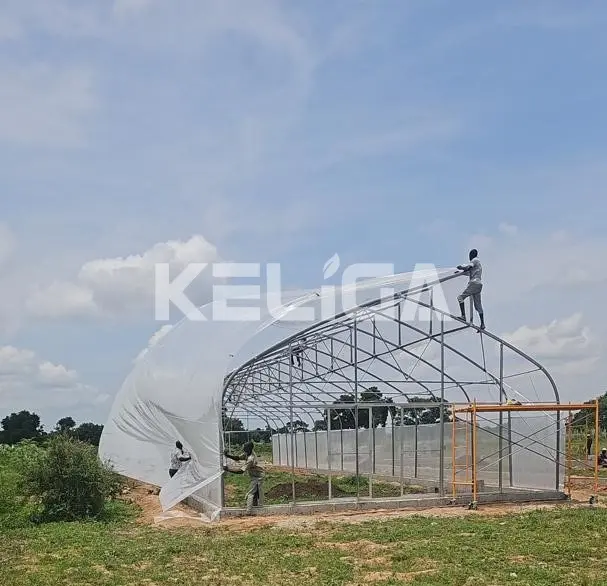


n 2018, we successfully exported and completed two units of 18m × 40m sawtooth greenhouses in Nigeria. This project represented a large‑span, high‑capacity solution designed for commercial growers seeking maximum growing area per structure and superior passive ventilation in Nigeria‘s tropical climate.
📍 Project at a Glance
| Item | Details |
|---|---|
| Greenhouse Type | Serrated / Sawtooth Design |
| Dimensions (per unit) | 18m (W) × 40m (L) |
| Number of Units | 2 sets |
| Area per Unit | 720 m² |
| Total Project Area | 1,440 m² |
| Location | Nigeria (South‑West region / Ogun State) |
| Completion Year | 2018 |
| Operational Status | Fully operational at completion |
The 18m width represents a significant structural span, achieved with hot‑dip galvanized steel trusses. Each 40m length provides a long, uninterrupted growing zone, ideal for high‑volume tomato, pepper, or leafy green production.
🌿 Why an 18m Wide Sawtooth?
Conventional sawtooth greenhouses are often limited to 9–12m spans due to ventilation and structural constraints. Our 18m design pushes the envelope while retaining the core advantage of passive cooling. Wide spans reduce the number of access aisles and maximize land use — crucial for commercial farms where every square meter counts.
The sawtooth roof orientation was set with ridges running east‑west to optimize the stack effect. The high vertical risers face north (in the northern hemisphere) or are adjusted for local wind patterns, ensuring continuous hot‑air exhaust even on low‑wind days.
🏗️ Technical Specifications (2018 Delivery)
Frame: Hot‑dip galvanized steel, bolted truss system
Span: 18m wide, multi‑bay (each bay 4–6m)
Length: 40m per unit
Eave height: 3m
Ridge height: 5.5m (vertical riser)
Covering material: UV‑stabilized polyethylene film (200 micron, 90% light transmission)
Ventilation: Continuous ridge vents along each sawtooth riser + roll‑up side walls (manual operation, upgradeable)
Additional systems: Drip irrigation kit, anti‑insect netting (40 mesh), trellising support wires
Foundation: Concrete pad footings for columns
📈 Performance Highlights (Post‑Completion)
Temperature reduction: 7–10°C lower than external peak temperatures during dry season. Internal peak around 38°C vs. >48°C in conventional arch‑type greenhouses.
Air exchange rate: 10–14 changes per hour (natural ventilation only), significantly higher than 2‑4 changes in standard peaked roofs.
Crop yield (first cycle): Tomatoes achieved 220 tons/hectare — approximately 30 times open‑field yield (7 tons/hectare).
Energy cost: Zero electricity for ventilation fans. Only minimal power for drip irrigation pumps (solar‑ready).
🏭 Why Two Large Units Instead of Many Small Ones?
These 18×40m greenhouses were designed for a mid‑size commercial farm or a cooperative that wanted simplified management. Two large units instead of eight small ones meant:
Fewer access roads and perimeter foundations
Easier climate management (larger thermal mass stabilizes day‑night swings)
Lower per‑square‑meter construction cost due to economies of scale
Faster daily operations (one walk through a 720 m² block instead of multiple small houses)
🤝 Strategic Fit in Nigeria’s 2018 Agriculture Landscape
In 2018, Nigeria‘s greenhouse sector was still emerging. Many pilot projects used imported standard designs that overheated. Our 18×40m sawtooth greenhouses served as a large‑scale proof of concept that passive ventilation works for big structures, not just small hobby houses. This project helped pave the way for subsequent government and private sector investments in climate‑appropriate greenhouse technology.
🔧 Support Provided (2018)
On‑site installation supervision by our technical team
Training for 4 local farm operators
Spare parts kit for film replacement and bolts
Basic structural warranty