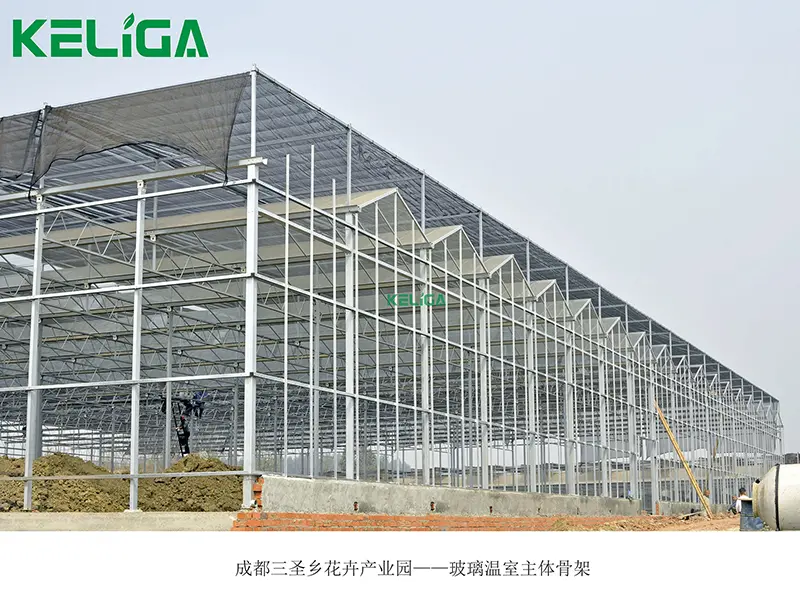
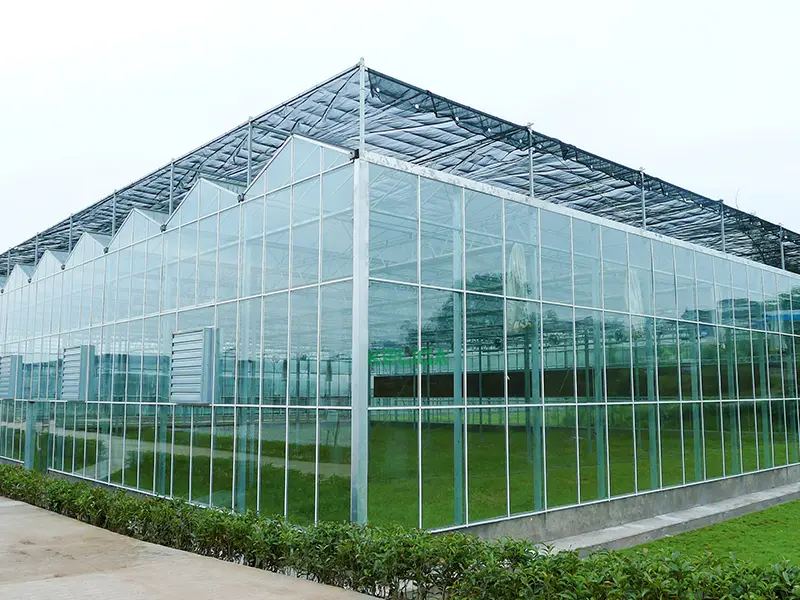
Standard glass greenhouse
The cost and construction cost of substrate cultivation are the lowest in soilless cultivation, and its practicality is significantly better than other soilless cultivation models.
Standard Glass Greenhouse: Product Overview, Design Standards & Global Applications
1. Product Description
The Standard Glass Greenhouse is the most widely adopted commercial greenhouse system globally, characterized by glass as its primary covering material and engineered for professional horticultural production. This premium agricultural structure consists of a galvanized steel or aluminum framework with tempered or horticultural glass cladding, mounted on a concrete foundation system.
Key characteristics:
High light transmittance (85–99%) – Glass offers superior and long-lasting light transmission that does not degrade over time, making it ideal for photosensitive high-value crops such as ornamental flowers, fruiting vegetables, and medicinal plants
Venlo-type (gutter-connected) configuration – The most prevalent design features a multi-span, ridge-and-furrow roof structure with a sawtooth-like profile. Standard configurations offer spans of 9.6 m, 10.8 m, or 12 m, with internal bays spaced at 3 m to 4 m, and gutter heights ranging from 2.5 m to 7.0 m depending on crop type and automation requirements
Superior ventilation performance – Venlo-type glass greenhouses provide exceptional natural ventilation through roof ridge vents and sidewall louvers, leveraging the stack effect to regulate temperature and humidity with minimal energy input
Durable hot-dip galvanized steel structure – High-quality Q235B steel with zinc coating thickness ≥ 275 g/m² ensures a service life of 20+ years with proper maintenance. Galvanized connectors and fasteners resist corrosion in high-humidity environments
Excellent thermal insulation options – Double-layer hollow glass (e.g., 4 mm + 9A + 4 mm, 5 mm + 6A + 5 mm) or single-layer tempered glass (4–12 mm) provides flexibility for different climate conditions, reducing heat loss through the glazing by up to 70–80% compared to single-pane systems
Fully compatible with automation systems – Designed to integrate external shading nets, internal thermal screens, fan-and-pad cooling, drip irrigation, CO₂ enrichment, and climate control computers
Resistance to aggressive environments – Rated for operation from –40°C to +60°C, with UV-stabilized components ensuring performance stability under extreme solar radiation
In summary, glass greenhouses provide growers with a high-quality planting environment through good light transmission, thermal insulation performance and supporting systems (automatic control, ventilation, irrigation, heating and cooling, nutrient circulation, etc.), which is conducive to plant growth and yield increase.
2.International Design Standards and Parameters
The design and construction of standard glass greenhouses are governed by regional and international standards that ensure structural integrity, durability, and operator safety.
2.1 Core Design Standards
| Standard | Scope | Key Requirements |
|---|---|---|
| EN 13031-1:2019 (EU harmonized standard) | Design and construction of commercial production greenhouse structures | Principles and requirements for mechanical resistance, stability, serviceability, and durability of greenhouse structures, including foundations, irrespective of construction material |
| EN 13031-2:2025 (pending full adoption) | Determination of controlled snow loads on transparent cladding of greenhouses open to the public | Specifies snow load assessment methodologies for public-access greenhouse cladding systems |
| NEN 3859 (Netherlands – foundational standard) | Greenhouses – Structural requirements | Requirements for strength, stiffness, stability and durability of greenhouses on horticultural farms, prototypes, and research installations |
| NEN 2674:2018 (Netherlands) | Greenhouse glass – Light transmittance | Sampling procedure and acceptance criteria for horticultural glass based on light transmission and scattering performance |
| ISO/TR 9492:1987 | Bases for design of structures – Temperature climatic actions | Reference document for structural design under varying thermal climate conditions |
EN 13031-1:2019 is based on the Eurocode framework (EN 1990, EN 1991‑1‑1, EN 1991‑1‑4, EN 1998‑1) with specific variations for greenhouse applications. Glasshouses are required to be designed to Serviceability Limit States (SLS), while flexibly clad structures may be designed to Ultimate Limit States (ULS) only
2.2 Key Design Parameters (Standard Values)
| Parameter | Typical Range | Notes |
|---|---|---|
| Roof spans | 8.0 m, 9.6 m, 10.8 m, 12.0 m | 9.6 m and 12 m most common for large-scale production |
| Bay spacing | 3.0 m, 4.0 m | 4 m spacing provides reduced column density |
| Gutter height | 2.5 m – 7.0 m | Higher gutters enable better air mixing and mechanized crop handling |
| Ridge height | 4.0 m – 6.0 m | Determines ventilation stack effect; taller structures achieve superior natural airflow |
| Roof slope angle | 23° – 26.5° | Venlo standard: 26.5° optimises light transmission and drainage; a 1:2 slope (≈26.5°) is typical for glasshouses |
| Wind load rating | 0.25 – 0.5 kN/m² (25–50 kg/m²) | 120 km/h wind speed equivalent in many configurations |
| Snow load capacity | 0.25 – 0.35 kN/m² (25–35 kg/m²) | Dependant on local climate conditions; NEN 3859 provides calculation rules for glass-coveredstructures |
| Heat loss coefficient (single glass) | Approx. 7.2 W/m²·K | Double glass (hollow) significantly improves thermal performance |
| Light transmittance | 85% – 99% | Single tempered glass: 90–99%; hollow glass (4+9A+4 mm): ≤ 85% |
| Glass thickness options | 4 mm / 5 mm / 6 mm / 8 mm / 10 mm / 12 mm | Single-layer tempered; hollow: 4+9A+4, 5+6A+5, 5+12A+5, 6+6A+6 |
| Maximum rainwater discharge | 100 – 120 mm/h | Integrated gutter and downpipe system |
2.3 Ventilation and Environmental Parameters
| Ventilation Parameter | Design Recommendation |
|---|---|
| Total vent area | 15–25% of floor area |
| Air changes per hour | 30–60 changes/h (minimum 1 exchange every 2 minutes; ideal 1 per minute) |
| Pad cooling efficiency | 75–85% evaporation efficiency; pad area: 15–20% of cross-sectional area |
Summary of Global Glass Greenhouse Market
| Parameter | Value |
|---|---|
| Global glass-covered share | Approximately 9% of total greenhouse acreage worldwide |
| Plastic-covered share | ~91% of total greenhouse acreage |
| Top glass-adopting country | Netherlands: 90% coverage, 17,000 ha, ~25% of global glass greenhouse area |
| Fastest-growing market segment | North America (driven by automation and year-round production demand) |
| Market growth rate | 2021–2028 projected CAGR: ~10.9% |
| Key drivers | Food security, climate change resilience, sustainable farming, demand for floriculture and ornamental horticulture, rising fruit and vegetable demand in developing economies |
- Ventilation system: In order to ensure air circulation inside the greenhouse, glass greenhouses are usually equipped with rack and pinion motor drive ventilation equipment to regulate air freshness and humidity.
- Heating and cooling system: In cold seasons, glass greenhouses are equipped with heating systems to maintain indoor temperature; In the hot season, equipped with a cooling system to prevent overheating.
- Automation control system: Glass greenhouses are usually equipped with advanced automation control systems that can monitor and adjust parameters such as temperature, humidity, and lighting in real time.
- Nutrient cycling system: Glass greenhouses are equipped with a nutrient cycling system that can recycle water and nutrients, improving resource utilization efficiency.

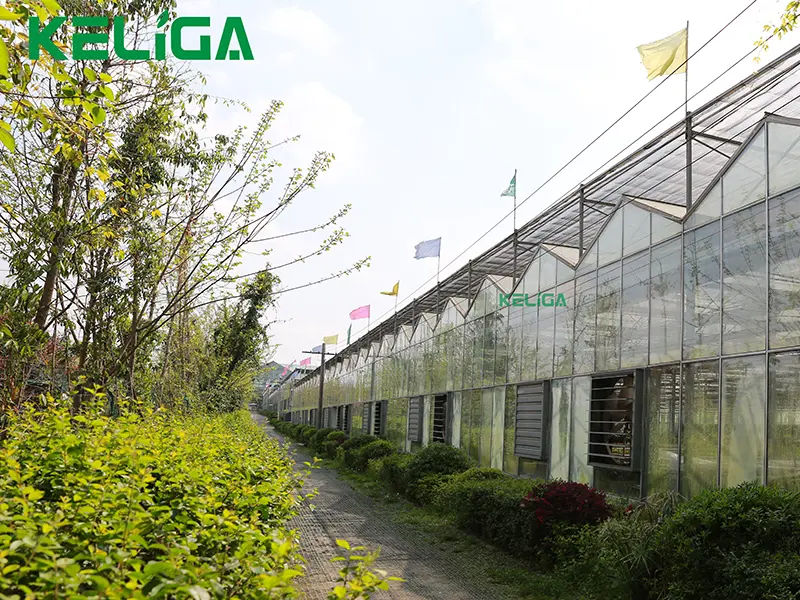
8,500 ㎡ Glass Greenhouse Vegetable Project in Westland, Netherlands
This high-tech glass greenhouse in Westland adopts high-transmission glass for sufficient natural light, boosting crop photosynthesis and yield. The modular steel frame features standardized components for quick assembly and stable structure. Intelligent climate control adapts to changing weather, realizing year-round soilless planting with low energy consumption and fewer pesticides.

12,000 ㎡ Glass Greenhouse Berry Project in Kent, United Kingdom
Located in Kent, this large glass greenhouse focuses on high-quality berry cultivation. Tempered glass delivers excellent thermal insulation and wind resistance, cutting heating costs in cold seasons. Pre-fabricated structural parts simplify on-site installation and later maintenance. It integrates drip irrigation and ventilation systems to create a stable growing environment and improve fruit commercial value.

6,800 ㎡ Glass Greenhouse Herb Project in Brugelette, Belgium
This professional glass greenhouse in Brugelette is designed for high-value medicinal herbs and greens. Clear glass ensures uniform light penetration to avoid uneven growth. The integrated drainage and sealing structure is easy to install and keeps the interior dry. It effectively isolates external pests, reduces disease risks, and supports sustainable and eco-friendly commercial planting.
R&D Focus Areas
We focus on several core R&D areas, dedicated to solving key direction challenges in the energy storage sector.
High-Transmission Glass Cover System
Adopts tempered or float glass with high light transmittance (over 90%), ensuring sufficient natural light for crop photosynthesis, and has good thermal insulation and wind resistance.
Intelligent Ventilation System
Equipped with top and side ventilation windows, controlled by sensors to automatically adjust air circulation, regulate temperature and humidity, and prevent crop disease.
Climate Control System
Integrates heating, cooling and humidification modules, intelligently maintains stable indoor environment, adapting to different regional climates and crop growth needs.
Irrigation and Fertigation System
Connects drip or spray irrigation equipment, precisely delivers water and nutrients to crop roots, improves utilization rate, and supports automated management.
Light Supplement System
Installs LED plant growth lights to make up for insufficient natural light in winter or rainy days, ensuring continuous crop growth and stable yield
Monitoring and Control System
Uses sensors to real-time detect temperature, humidity, light and CO₂ concentration, realizing remote intelligent monitoring and precise management of the greenhouse
R&D Focus Areas
We focus on several core R&D areas, dedicated to solving key direction challenges in the energy storage sector.
Our Process
Steps to Your Greenhouse
1. Consult
We begin with a personalized consultation to capture your vision and needs.
2. Design
Our experts craft a detailed plan with eco-friendly practices for your approval.
3. Execute
Our skilled team transforms your space with precision and care.
The Goal
Our Mission
To transform outdoor spaces into beautiful, functional, and sustainable environments that enhance our clients’ lifestyles while respecting the natural world. We are committed to delivering exceptional service and innovative solutions through our passion for gardening and landscaping.
The Outlook
Our Vission
To be the leading provider of eco-friendly gardening and landscaping services, inspiring communities to embrace sustainable practices and appreciate the beauty of nature in their everyday lives. We envision a future where every outdoor space reflects harmony between human creativity and the natural environment.